


/ PRESENTATION
FLASHBACK - L'immagine fantasma
Press Release
FLASHBACK, The Ghost Image is the project by Marco Grassi Pho exhibited from May 21 to July 4 in the windows of SpazioC21 at Palazzo Brami, Via Emilia San Pietro 21, in Reggio Emilia, as part of the OFF section of Fotografia Europea 2021 edition.
In the era of fast, instant digital photography, Marco Grassi Pho offers a personal reflection on the slow time of photography. Photography without a camera. Contact photography. A tribute to the experimentation of Man Ray and to an analog image development technique now lost in the mists of time.
The group of exhibited works – consisting of three large format rayographs and one medium format – is a poetic and imaginative reading of a topical element of the metropolitan landscape, the wall; a homage to the memory of the wall, to the illusion created by shadows and the spectrum of worn stratifications, and to what those walls themselves may have conveyed and that time has not preserved.
In his rayographs, Marco Grassi Pho captures an unprecedented aspect of the urban landscape: the perspective of the ephemeral, fleeting, decadent trait; the aesthetics of faded images, of border crossings. He offers a non-didactic, dreamlike representation of the wall, straddling reality and surrealism. He gathers information, details, data, and whispers from material elements; transforms matter into essence; and returns it in a new aesthetic code.
His imaginary wall, captured in black and white on hand-colored cotton paper, speaks the languages of the tribes that wrote, scratched, and scarred it; it speaks about the messages that covered it, the love it witnessed, and the fury of which it was an innocent medium. It reveals, upon closer inspection, its multiple cultural and social dimensions. Walls ooze politics, customs, art, and sociality.
Using the photogram technique, which captures an image by contact with photosensitive material, Marco Grassi Pho explores the most authentic dimension of the photographic medium and builds a bridge between the Dada aesthetics of Man Ray and that of nouveau réalisme, paying tribute to the décollages of François Dufrêne, Raymond Hains, Jacques Villeglé, and Mimmo Rotella.
The rayographs on display at SpazioC21 are large and medium format impressions, in unique pieces; entirely analog executions, “photographs” that do not use a camera but are obtained by simply interposing the negative between photosensitive paper and the light source.
Flashback. The Ghost Image is not only an exhibition of Fotografia Europea 2021 but also a limited edition artist’s book of 100 copies for sale, each with an original rayograph, priced at €200.
The critical text accompanying the installation is written by Simone Pallotta, the photographs were taken by Fabrizio Cicconi, and the documentary is directed by Paolo Freschi.
FLASHBACK. L’immagine fantasma
Simone Pallotta
The technical process that leads to the works you are viewing is a fundamental element of their charm. Every single stroke, shade, or shape results from a work that originates from the curiosity about materials and the search for their hidden essence, a universe of signs and concrete details that seem to emerge from the paper’s surface.
Raised in abstract painting, Marco Grassi finds in a photographic technique a new experimental territory that allows him to achieve a living abstraction, surfaces that vibrate and return information, echoes of matter. The bromograph is a contact printing tool, at first glance a wooden box with a glass top. Inside the box are light bulbs. On the glass plane, scraps of old posters and photographs of wall textures are placed, with emulsion-coated photographic paper on top, ready to absorb light. Once the lid is closed, pressure adheres the paper to the artist’s composition and this to the glass; then the photographic paper is exposed by turning on the internal lights.
Beyond composition, the artist works on many variables he can only try to control, never fully: the type of paper, fixing times of the emulsion, the amount and timing of light exposure, and the final drying. The materials, objects, or elements discussed are things we usually ignore: small pieces of papers with different grains, crumpled and then reopened, scraps of posters, photos of walls printed in negative, portions of surfaces from the visible world carefully composed to manifest a different identity, transforming into abstract textures making their way over recognizable surfaces. The result is not a photograph, though created with light, but an impression, an image projecting us into a half-unknown world where these “urban” and superimposed elements enter an abstract dialogue that surprises viewers by attracting them with something seemingly familiar but never strictly adherent to known reality.
In photography’s early days, the bromograph served to reproduce negatives on paper; Marco Grassi transforms it into a narrative mode where selected elements lose their original appearance and are recomposed, mixing to create new surfaces.
We feel the “presence” of materials, but what we see results from compositional choices considering not only the type and position of objects but especially how they filter light. The result is a complex stratigraphy of signs, a sedimentation of organic and inorganic ghosts, a dynamic balance of chance and attempts, a very high-contrast black and white where surfaces and marks mimic the grain of an old wall with scratches and stains, peeling plaster, and years of accumulated dust. In these humble aesthetic works, where echoes of Kline, Vedova, and Brassaï’s photographed walls emerge, the artist’s research is evident. We sense graffiti, work on signs and gestures, attraction to textures of things and nature, the effort to seek meaning beyond the pictorial act by painting with light, the very matter of painting. Thanks to light, materials acquire an “other” nature, partly governable by humans and therefore mysterious. They help us perceive the sensation of their presence and understand the essence of abstract painting: to look at something that did not exist before, something that lives only in the artwork.
Artist’s Book
FLASHBACK. The Ghost Image.
by Marco Grassi PHO
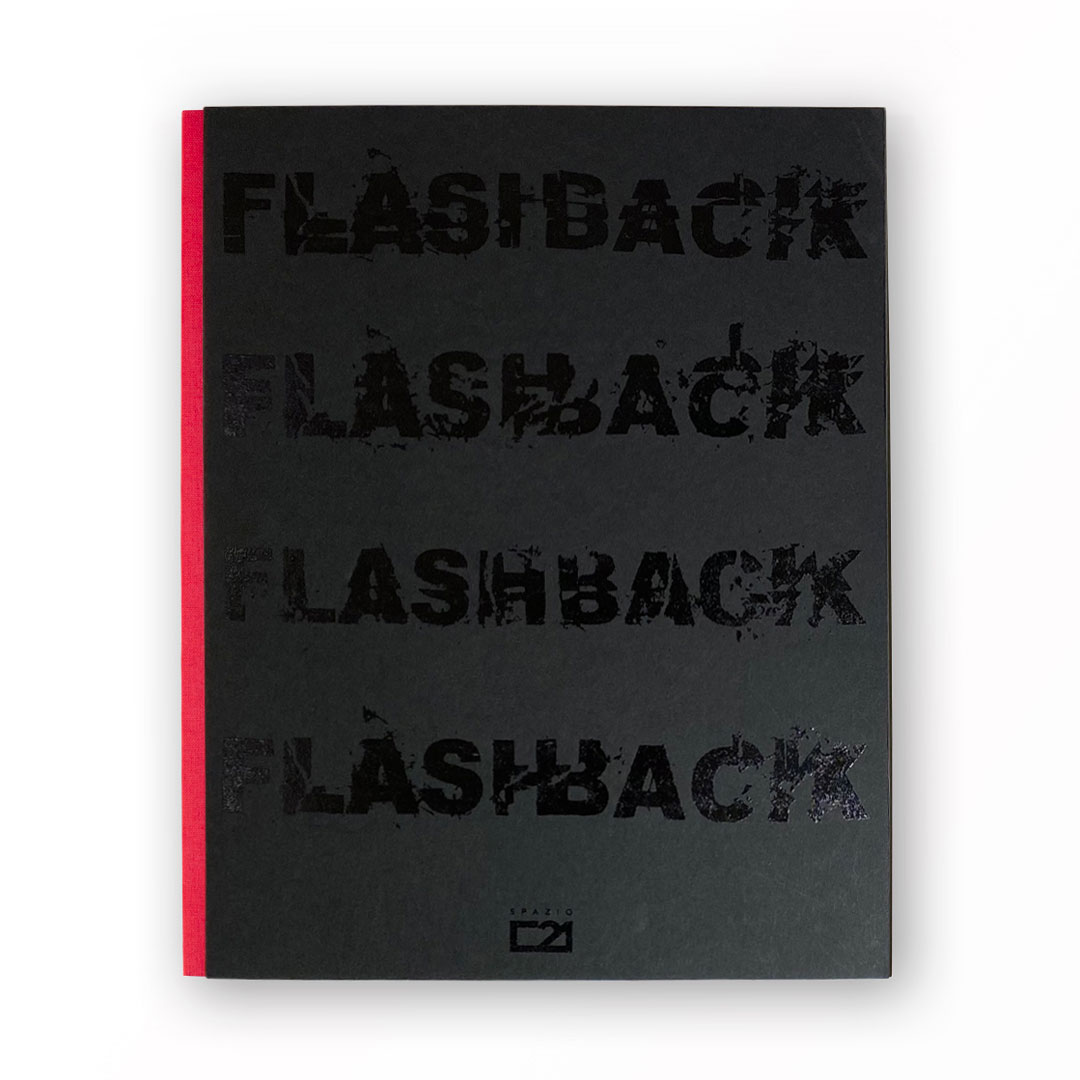
On the occasion of the exhibition FLASHBACK. The Ghost Image by Marco Grassi PHO, SpazioC21 produced an artist’s book of the same title.
The publication consists of 99 copies: 90 standard editions numbered 1-90 in Arabic numerals, and 9 special editions numbered I-IX in Roman numerals. It was printed in Reggio Emilia by Tecnograf in April 2021. The book is quarto format (28.5 x 22.4 cm), 64 pages, offset printed on intercalated Free Life papers 170 gr and 250 gr, with red half-cloth thread binding and 2mm sumo black cardboard covers silk-screened; it contains a photographic print on acetate (10 x 15 cm), 7 stickers of various sizes (4 loose), 2 red paper foldouts (22.5 x 33 cm), 4 photographic reproductions of works by Marco Grassi Pho for the exhibition project (19 x 15.5 cm), and an original rayograph (24.9 x 19.8 cm) signed by the artist.The production of this artist’s book was commissioned in 2018 by SpazioC21 for the Fotografia Europea 2020 event, postponed to 2021 due to the COVID-19 pandemic.
The volume collects a selection of photographs made in 2014 by Donata Clovis (1976–2016) to document the photographic research project of the Milanese collective Le Grand Verre by Marco Grassi Pho and Matteo Bologna (1977–2015).
For the book’s realization, SpazioC21 collaborated with Giacomo Spazio (Sstars Lab) who conceived and designed it; Simone Pallotta, who wrote the texts; Giuseppe Iotti (lo Studio) for print supervision; and Fabrizio Cicconi for photographic reproductions of Marco Grassi Pho’s works.
The Flashback exhibition, which this volume complements, was set up at Palazzo Brami, Via Emilia San Pietro 21, Reggio Emilia, from May 21 to July 4, 2021.