/ PRESENTATION
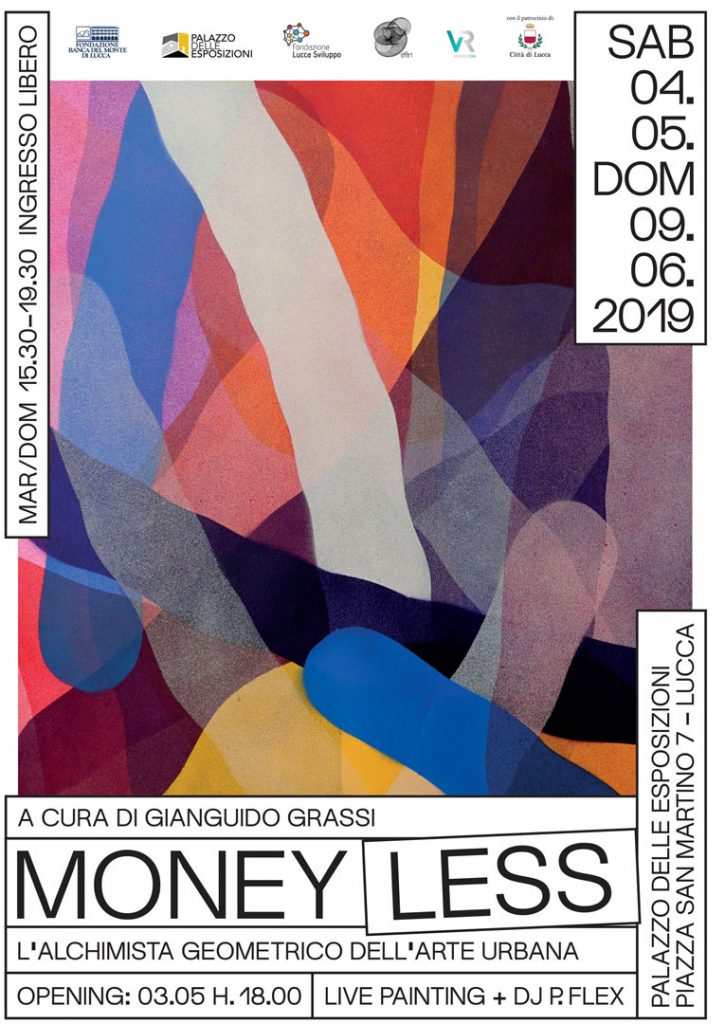
MONEYLESS, The Geometric Alchemist of Urban Art
by Gian Guido Maria Grassi
The exhibition Moneyless – The Geometric Alchemist of Urban Art, curated by Gian Guido Maria Grassi, is dedicated to one of the most renowned contemporary artists to emerge from the Lucca area.
Moneyless, born Teo Pirisi (Milan, 1980), had just returned to Lucca after a major project in Sweden—where he painted an entire gallery—and was preparing to leave for the United States to take part in several events. Today, he is internationally recognized as both a pioneer of abstract muralism in Italy and one of the few to have successfully brought it from the streets into museums.
Organized by the Fondazione Lucca Sviluppo and the Fondazione Banca del Monte di Lucca, with the collaboration of the association StART – Open Your Eyes and the patronage of the City of Lucca, the exhibition is part of a broader series of initiatives dedicated to urban art in the Lucca area. In 2018, Moneyless had already created the first two institutional murals in San Vito for the stART Festival project.
This exhibition offered an opportunity to explore, through one of its leading figures, what is commonly known as Street Art—the most disruptive and global artistic movement of the past forty years. Street Art has transformed the collective imagination, sparked urban and social change, and is characterized by a wide range of expressive languages, diverse influences and traditions, a variety of materials, and a multitude of formats and spaces. This multiplicity has only expanded as Street Art has evolved: from spray cans to brushes, from illegality to institutional recognition, from underground jams to art festivals, from train yards and abandoned factories to collaborations with major fashion brands, commercial enterprises, prestigious galleries, and museums.
This marked the first official entry of Street Art within the historic walls of Lucca’s city center.
For the occasion, the Palazzo delle Esposizioni was outfitted in a completely new way. Transformed in 2019 into a canonical museum-style white cube, the space featured an innovative display of paintings, drawings, prints, and sculptures. Notably, it also allowed the artist to create five temporary wall paintings that broke the boundaries of traditional formats and expanded across the architectural surfaces. Additionally, two installations were created, including one on the façade of the auditorium (formerly the Oratory of the Madonnina) in Piazza San Martino. This installation, made using thread anchored to nails already present on the wall—normally used to support the lights of the traditional Luminaria di Santa Croce—resulted in a visual short-circuit, connecting contemporary, disruptive artistic language with the city’s classical and historical material dimension.
The nearly 100 works on display—most from private collections and museums—allowed viewers to understand the poetics, technical evolution, and formal development of Moneyless’s work. Through rich photographic and video documentation, the exhibition traced his career as a street artist, highlighting the essential relationship between works created in the studio for indoor settings and those realized outdoors on a large scale for public spaces.
“The name Moneyless is closely linked to my way of working. Distant from the relentless consumption of the contemporary world, I pursue simplicity and essence as core values. Society is overloaded with images and sounds—a great chaos that ultimately communicates nothing. The richness of a minimal form, to me, lies in its poverty: it’s a silence that brings thought back to the surface.”
From this reflection arises Teo Pirisi’s ongoing research, rooted in an exploration of the fundamental relationship between nature and geometry—sometimes in a static, ontological sense, and other times in a dynamic, historical one. His works explore this evolving relationship through contrasting yet interconnected elements such as matter and energy, reason and freedom, light and spirituality, color and movement, form and space. From the musical interplay of these forces, a wide variety of series have emerged—works in which his aesthetic inquiry runs parallel to an almost alchemical quest for the purity of form, which, like a Heraclitean flame, always seems to elude grasp in its constant becoming.
This retrospective exhibition thus offered an insightful journey through Moneyless’s oeuvre, demonstrating the logical and stylistic coherence of his work—without ever losing the graphic power and expressive force rooted in his underground, graffiti-based adolescence in the 1990s.
A catalogue was published to accompany the exhibition, chronicling Moneyless’s distinguished artistic career through a substantial body of artworks and public interventions. These include pieces created on five continents—from Milan to Los Angeles, Madrid to Istanbul, Buenos Aires to Perth—as well as those developed specifically for Lucca.
The exhibition was enriched by guided tours, talks, events, and community initiatives. Highlights included a film screening (Basquiat) on Friday, May 10, 2019, at the Cineforum; guided tours on May 5, 11, and 18; a public conference for architects titled Urbanism & Street Art on May 29; and the presentation of the exhibition catalogue on June 6. Before the end of the 2019 school year, educational activities—including workshops and school visits—were launched, particularly involving students from the Passaglia Art High School in Lucca.