
/ ARTWORKS
STREET DIALOGUES
#6
JULY-SEPTEMBER 2020
HAMBLETON, EVOL, JOYS e EGS L’UOMO E LA CITTÀ,LE LETTERE E I LORO CONFINI.

RICHARD HAMBLETON
Shadowman
New York, 1983
Acrylic on recycled paper poster
177 x 117 cm
© Ph. Dario Lasagni
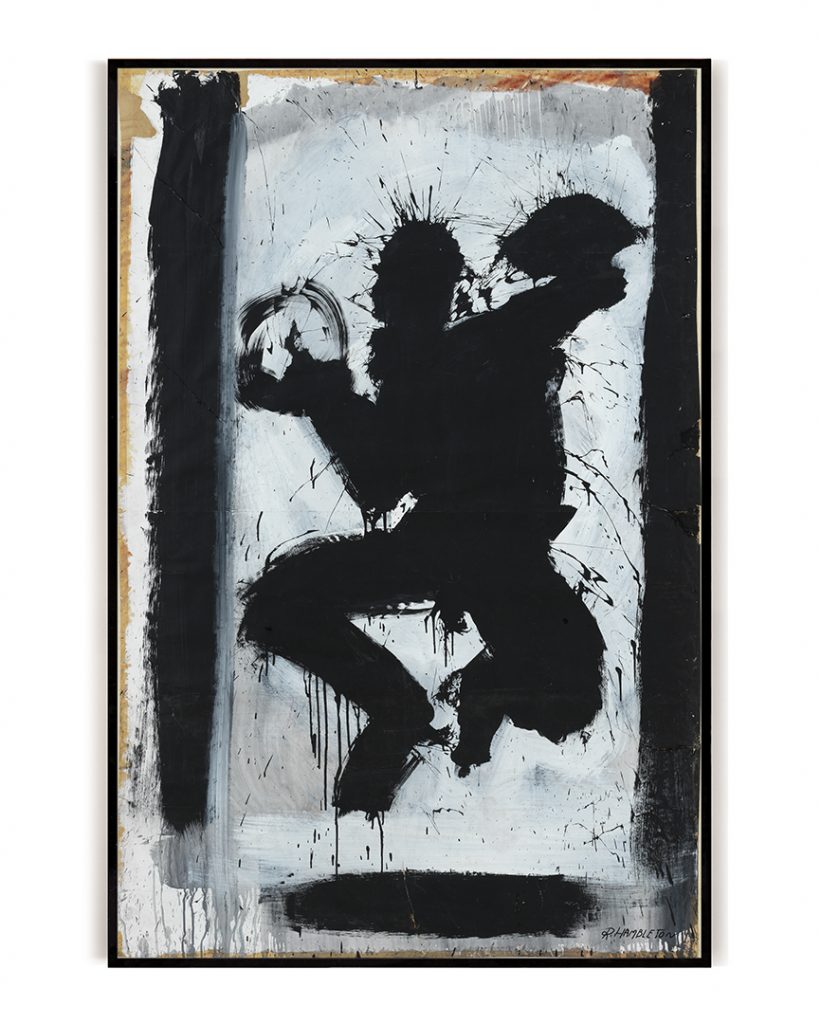

RICHARD HAMBLETON
(Vancouver 1954 - New York 2017)
An expressive and gestural painter, Richard Hambleton graduated in fine arts from the Emily Carr School of Art in Vancouver. He was among the first artists in the New York scene to use the city as a canvas, bringing figurative art into the streets and energizing the emerging Lower East Side scene. Due to context and affiliation with adjacent artistic circles, his early street works have been compared to graffiti practices, although Hambleton had no roots in writing; he was formally trained in art and fully aware of the artist’s role within the urban environment.
His work earned him the title of “godfather of street art.”
His entire production is collected in series — Mass Murder, Shadowman, Marlboro Man, Beautiful Paintings. The Shadowmen — mysterious and restless life-sized silhouettes painted on walls in New York and many other cities starting from the early 1980s — were exhibited in 1984 at Arte di Frontiera. New York Graffiti, the first exhibition (held in Bologna) to introduce the Italian public to the latest trends in American art, featuring artists like Keith Haring, Jean-Michel Basquiat, Kenny Scharf, and established writers such as Rammellzee, Futura, Phase2, Dondi, and A-One alongside Hambleton. Since then, his work has been shown twice at the Venice Biennale — in 1984 and 1988 — and has entered numerous permanent collections, including that of MoMA.
EVOL
Untitled
Rome, 2003
Stencil on recycled cardboard
168 x 75 cm
© Ph. Dario Lasagni
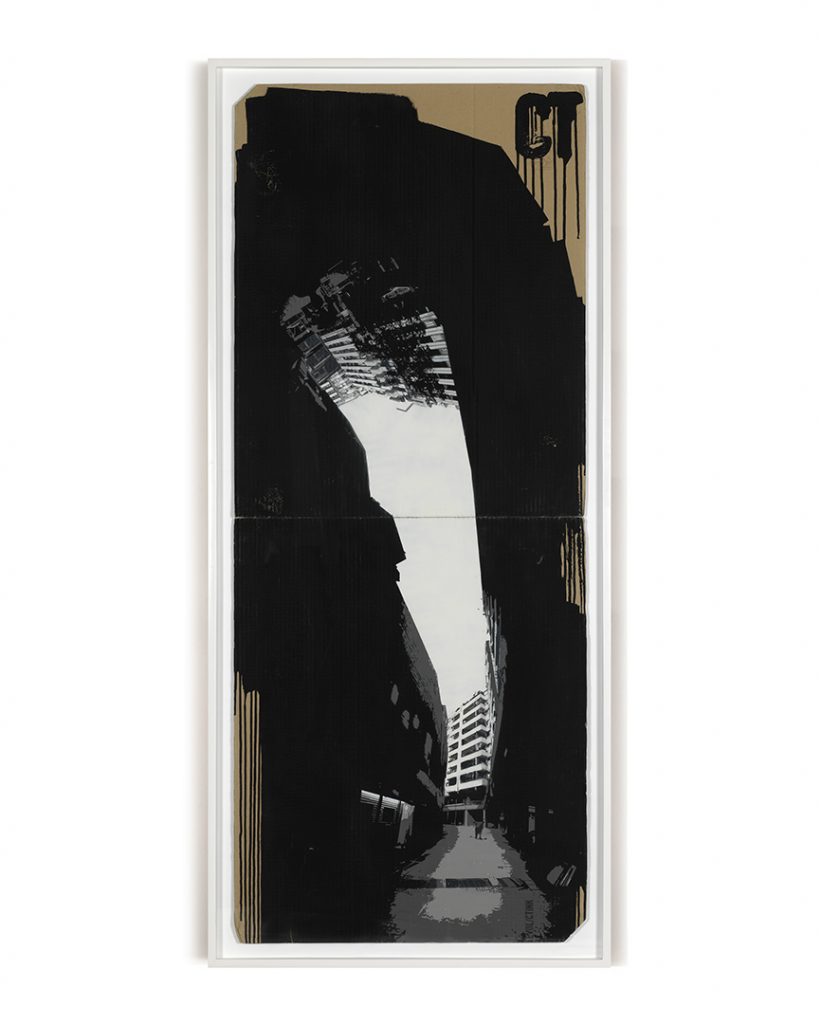
EVOL
(Berlino 1973)
The alienating and anonymous dimension of the city is at the heart of Tore Rinkveld’s work, aka EVOL, who creates a body of art focused on the metropolis, its life, and its decay using stencils or airbrush techniques. EVOL transforms urban furniture elements into microscopic, sterile, and uninhabited condominiums. Through scale inversion, EVOL emphasizes details and the contrast between the disorienting allure of brutalist architecture and the grayness of decomposed and shattered concrete. His work investigates and reinterprets the anonymity of dystopian suburbs built by socialist post-war architects in former East Germany, emphasizing their decay as a mirror of contemporary society. A miniature imaginary world rich in details, unnoticed elements, and contrasts of light and shadow.
In parallel, EVOL explores ordinary architecture in Berlin neighborhoods that survived the world wars. The background surfaces in his artistic production are always found objects or waste materials such as electrical cabinets, cardboard packaging, or concrete.
EVOL graduated from the Kuopio Academy of Arts and Crafts (Finland) in 2000 and from the HFG Schwäbisch Gmünd (Germany) in 2001. She has exhibited internationally, both in public spaces and in museums and galleries.


JOYS
Love
Padua, 2011
Plexiglas
103 x 104 cm
© Ph. Fabrizio Cicconi
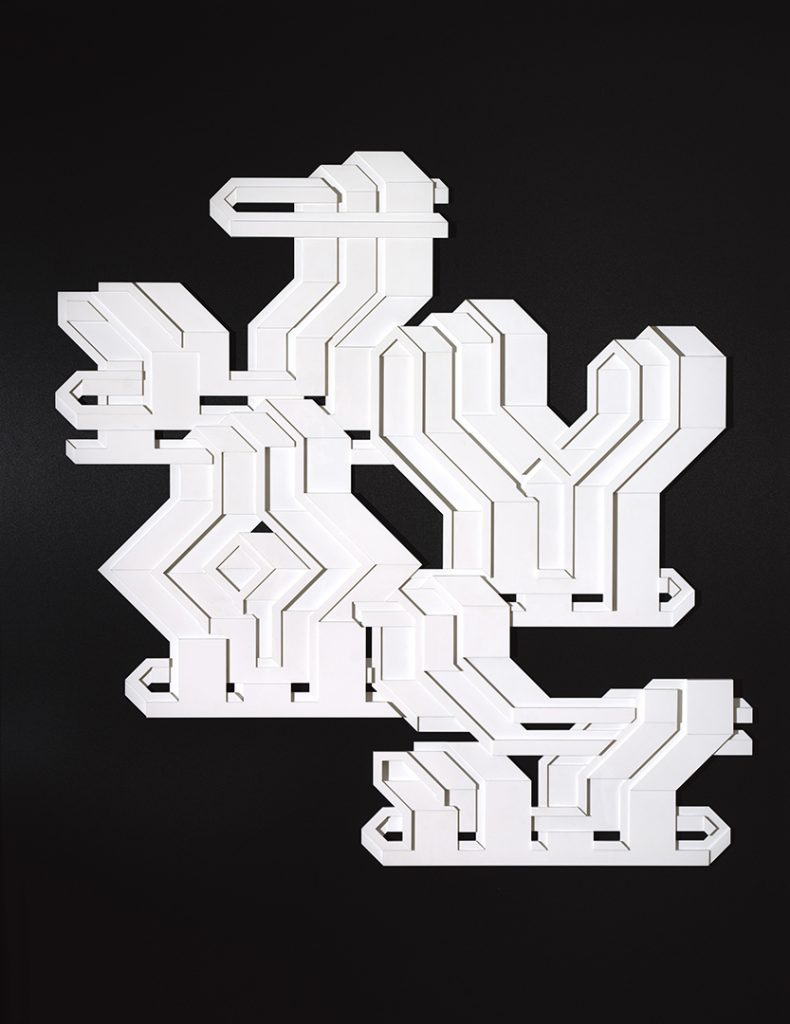
JOYS
(Padua, Italy 1974)
JOYS was born in Padua in 1974, and his introduction to Graffiti dates back to the early 1990s. His aesthetic research and meticulous study of 3D lettering have long been recognized as original and innovative. In the early 1990s, he co-founded the crew EAD with Peeta, Etnik, and Made214, famous for their three-dimensional tag executions and for the aesthetic innovation they brought to the Italian graffiti scene. Within this crew, Joys developed his own independent aesthetic path. Through composition and the combination of colors and materials, his letters have been deconstructed and transformed into abstract constructions, impossible labyrinths, and perfect geometries with carefully researched chromatic contrasts. Joys’ work has transcended the two-dimensional level — beyond the surfaces of walls and trains — giving rise to sculptural production that benefits from expert research on materials and construction techniques and has crossed national borders with commissioned works in the East and the United Arab Emirates.
EGS
Fragile Identity #2
Helsinki, 2016
Hand blown glass sculpture,
26,5 x 16,5 x 5 cm,
30 x 15 x 17 cm,
35 x 17 x 15,5 cm.
© Ph. Dario Lasagni

EGS
(Helsinki 1974)
Finnish by origin, EGS is one of the most prolific writers of his generation and one of the main artistic talents of his country. Active since the mid-1980s, he has traveled across five continents, built an extensive network of relationships, shared experiences with the best artists in his movement, and left his marks on trains and walls worldwide.
He is recognized as a great innovator for the unique and ever-changing style of his letters; since the early 1990s, he has explored free forms, completely opposite to the New York wildstyle concept, anticipating a tendency toward abstraction found in his more mature works created for exhibition spaces.
His studio work — including glass-blown sculptural production — has progressively become more sophisticated and abstract, showing us the infinite manipulative possibilities of letters while maintaining their original roots.
EGS’s latest aesthetic research investigates the ephemeral nature of boundaries, both natural and political, and the implications of climate change on them.
In 2018, he held a public retrospective titled Writing my diary at the Kunsthalle in his city — long the capital of “zero tolerance” toward writers — and in 2020, he was selected among the artists invited to the Biennale at HAM, Helsinki Art Museum.Nel 2018 ha realizzato nella Kunsthalle della sua città – capitale per molti anni della “zero tolerance” verso i writer – una restrospettiva pubblica dal titolo Writing my diary e nel 2020 è stato selezionato tra gli artisti invitati alla Biennale dell’HAM, Helsinki Art Museum.
STREET DIALOGUES
#6
JULY-SEPTEMBER 2020
HAMBLETON, EVOL, JOYS e EGS L’UOMO E LA CITTÀ,LE LETTERE E I LORO CONFINI.